The enemy in the Alien series of movies is not the eponymous xenomorph. The enemy is ourselves.
(Obviously this post will discuss each movie – Alien, Aliens and Alien 3 – and will include spoilers. If you haven’t seen the films yet, go watch them, then return here).
Inspired by HR Giger’s biomechanics designs, the nameless alien of the three movies of the original trilogy is purely animalistic and evolutional, in the same way that the life cycle of the parasitic wasp is pure: the alien exists to reproduce and survive. The alien uses other living creatures as hosts for its life cycle, and protects itself. Morals cannot be applied to it, and it is the human conflict in each movie that causes the majority of harm and destruction.
Parker: “If they find what they’re looking for out there, that mean we get full shares?”
Ripley: “Don’t worry, Parker. You’ll get what’s coming to you”
Politics is merely human conflict and interests writ large, and I would argue that each of the films encapsulates a different political experience: classical Marxist struggle inAlien, capitalist colonialism in Aliens, and anarcho-syndicalism in Alien 3. It is this very human conflict that draws us into each film: as much as a modern audience may enjoy watching explosions and ichor-dripping threats from the Big Bad, what makes us care about a movie are other people.
In Alien, those people are divided into several political classes. Dallas, the captain of the Nostromo, is nominally in charge, although his appearance of command is a facade. What is actually in control – leading the ship into danger and bringing a dangerous (but potentially profitable) unknown entity onboard – are the forces of capitalism, in the form of the Weyland-Yutani Corporation, represented on the ship by the calculating bourgeoisie android Ash.
Sweating as they work in the humid bowels of the ship are Parker and Brett, the proletariat. Constantly complaining about overtime and extra pay, they are contemptuous of the command structure above them.
The crew of the Nostromo are betrayed for the possibility of profit, just as in the sequel,Aliens, naive colonists are sent to investigate the alien wreck on LV-426 when Weyland-Yutani knows that a threat exists on the planet.
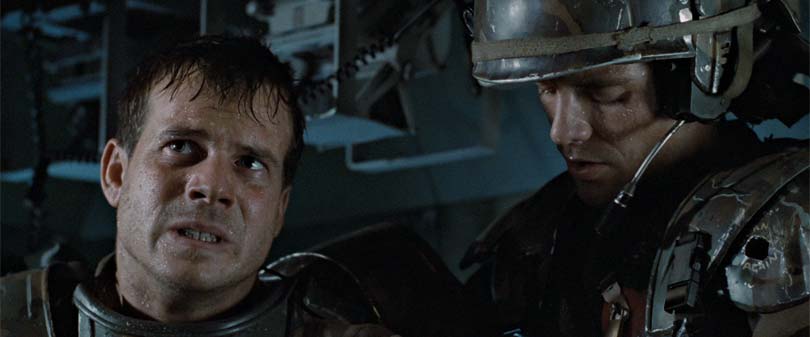
Hudson: “Hey Ripley, don’t worry. Me and my squad of ultimate badasses will protect you.”
James Cameron deliberately paralleled the American military experience of Vietnam in the sequel: well-armed, arrogant and cocky, the Colonial Marines, tools of capitalism, are sent to protect an outpost that is already lost, taken by a force that they do not understand. Firepower and bravado are no match for a tenacious enemy who does not share your strategy, goals, or ways of thinking.
Probably the weakest movie of the series in terms of plot (not helped by the fact that the script was a hodgepodge blend of multiple drafts penned by different writers), Alien 3 moved to a prison planet. Neglected by the cosmos outside and largely self-sufficient, the prisoners on Fury 161 have formed their own monk-like social structure, complete with shaved heads and cowls, in which the warden is little more than a conduit for a trickle of supplies. They organize their own resistance against the alien, and succeed; the escape of the alien is due to the actions of one disturbed convict, driven out of his mind by encountering savage alien life in the context of his apocalyptic millenarian belief system.

Seen in this way, the original trilogy (and potentially the prequel, Prometheus, currently being filmed by Ridley Scott with artistic input from H.R. Giger) is a progression through a Marxist view of history, an evolution through political forms, as well as being great science-fiction horror.