There are, broadly speaking, two different audiences for science fiction movies. The first group is impressed by epic scale, for whom the “science” is incidental; in this way, Star Wars is simply a fairy tale of knights and princesses in space. The second kind of audience takes science seriously: the more grounded in reality the film presents itself, the greater the expectation of accuracy.
Both audiences can exist in one and the same person: I can enjoy a space western like Firefly alongside a hard science fiction movie like 2001. Enjoyment of a film is a question of the rules the movie sets up for its audience, and the ambition of its creators.
Christopher Nolan is a director who has never been short of vision: the man rescued and resurrected an entire franchise from camp and morbidity. But while breathtaking, his latest work, Interstellar, has exceeded his grasp of science and storytelling.
From Hardscrabble To Hard Vacuum
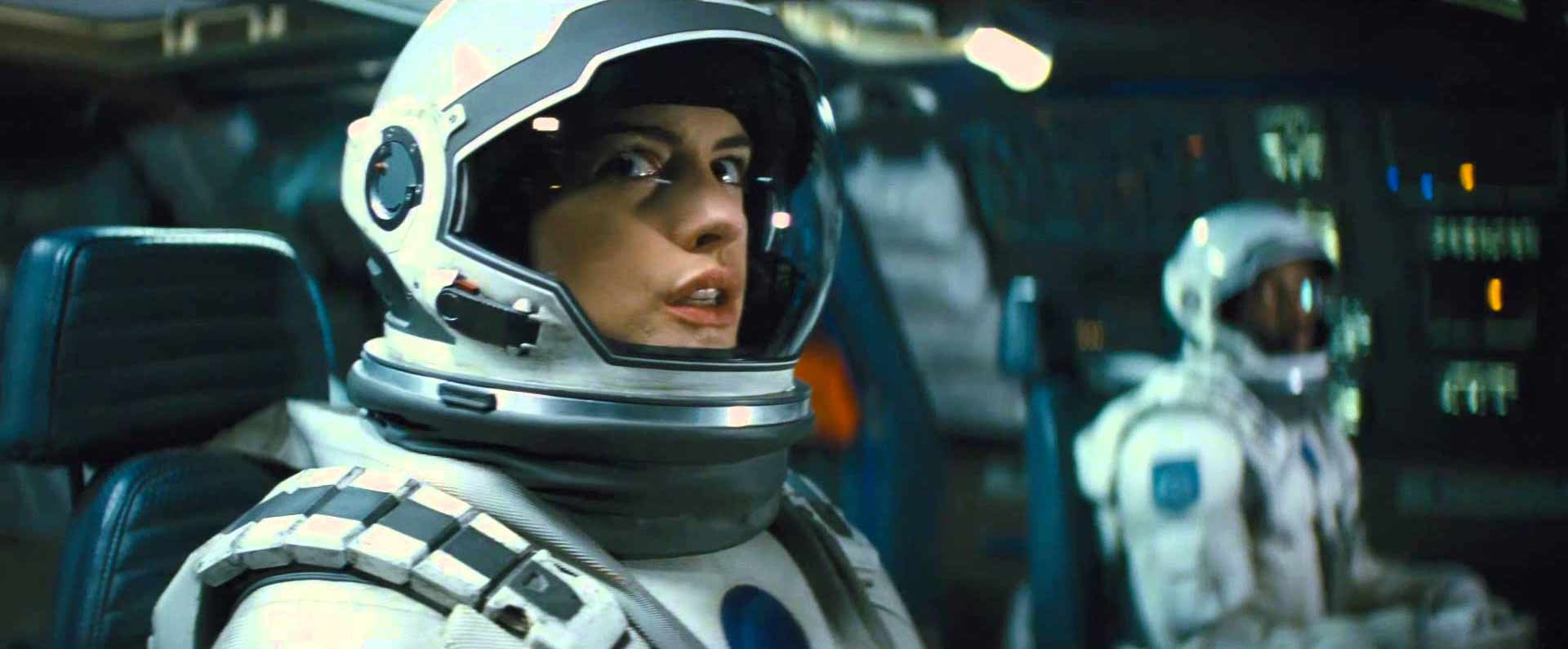
The film’s opening is excellent: a series of vignette interviews with septuagenarians blurs reality, making it unclear if they are talking about the Dust Bowl of the 1930s, or the ecological disaster faced by humanity in the movie, set some 50 years into the future. Blight is killing crops worldwide, forcing even highly qualified pilots like Cooper (Matthew McConaughey) into a dirt-poor farming life in Texas (in reality, filmed in various locations around Alberta). Prompted by his daughter, Cooper discovers a message written in the layered dust on the floorboards of his house, which leads them to the coordinates of a hidden launch site where the remnants of NASA live and work. There, Cooper learns that the messages are from an extraterrestrial intelligence, communicating with earth for the last four decades. This same intelligence has somehow formed a wormhole in orbit around Jupiter, which leads to a location in a distant galaxy: habitable worlds, orbiting a supermassive black hole. Probes have been sent through, together with the first explorers, but all of these journeys have been one-way trips: the data that comes back has been tantalizing, but inconclusive, in part due to the spacetime effects around the black hole, where time moves much slower, relative to time back on Earth. NASA convinces Cooper and an assembled team to take one last voyage out of the solar system to find a future home for humanity, not knowing how long the journey might take, or what they might return to.
The setting is epic in scale, and very reminiscent of 2001: A Space Odyssey. Nolan and science consultant Kip Thorne have received plaudits for accuracy, particularly in the depiction of the black hole Gargantua. The movie even shows some of the exterior space scenes in silence, as they should be, there being no atmosphere in space to transmit sound.
However, this is counterbalanced by several serious mistakes in the movie. Against the silence of space, Hans Zimmer’s score is almost punishingly loud, as if the composer suffered a heart attack while playing a pump organ: the sound is so bombastic that it obscures the film’s dialog at several points. The plot suffers from the usual “aliens can only communicate cryptically” trope, which leads to several questions:
- Why wouldn’t the vast alien intelligence communicate how to fix Earth’s environment, rather than the far more complex challenges of quantum gravity and interstellar travel?
- When our own Milky Way has 100 million stars, most of them with worlds of their own, and an equal number of suns floating in a halo around the galaxy, why do the aliens lead humanity to the supermassive core of another galaxy, one of the most zones most inimical to life?
- Black holes do not give off light or heat, aside from their accretion disks. So where does the daylight come from on the planets the explorers discover?
- Gravitational tidal forces absolutely stretch time, but not over the distances the film portrays: it’s not possible for descent from orbit to a planet’s surface to change subjective time by years.
Presenting a hard science fiction film is very much like presenting a scientific hypothesis: the creator is allowed one “blue fairy” – a complete supposition, without any supporting evidence. Add more fairies, and the hypothesis melts into fantasy; the same is true of hard SF.
Why Is This Important?
Many will object to this view of “it’s just a movie”, but this is more than that: it’s a movie with pretensions of hard science. There’s nothing wrong with that, and there is always a certain degree of artistic license that can be granted, but communicating the facts of science is important. Science is awesome: interstellar travel doesn’t need the impossibility of frozen clouds on extraterrestrial planets to be awe-inspiring.
Heart Over Head
Emotionally, the film explores themes of love, loss and yearning very effectively, although it dips into nonsense new-age speak a few too many times; this is particularly jarring when the words come from the mouths of scientists who should know better. (To his credit, Nolan places women with important science roles in almost equal proportion to male roles, but also plants some of the dumbest “woo” dialog in their mouths). In the end, the movie ties itself in a paradox without an answer, placing emotion over any sense of logic.
Conclusion
I’m sure there are audiences who will simply enjoy the movie for its sense of scale and spectacle – particularly on an IMAX screen, as I saw it – but to me the movie was a disappointment. Visible, under its skin, is a glimpse of what could have been done, if Nolan’s ambition had not pushed the movie to ever more-dizzying heights.