Now that the Tories have been elected to a majority in the 2011 Canadian government, the controversial proposal to purchase 65 American F-35 fighter jets for the Canadian Air Force is likely to move forward.
The F-35 program has been deeply troubled since its inception. Aside from the projected cost for Canadian taxpayers – almost $30 billion over the 30-year lifespan of the airframe (far larger than the initial estimate of $9 – $16 billion) – the Canadian government’s very participation in the program is a fait accompli: no competitive bidding process to replace Canada’s aging CF-18 fleet was ever entered into (ignoring Ottawa’s own contracting regulations), and no alternatives were ever seriously considered. If Canada stays in the program, the nation pays whatever price the F35 is delivered at.
Most media coverage has focused on the ballooning costs of the program and the lack of a competitive open bidding process. But purchase of the F-35 is wrong for Canada for far more fundamental reasons.
Role
The F-35 is a high-thrust interceptor designed primarily for air-to-air engagements with targets beyond visual range and limited targeting of ground installations after most detection infrastructure has been destroyed, neither function ever used by the Canadian military. That does not mean that the airframe cannot be adapted into other roles, but its suitability for domestic service must be seriously questioned.
Canada’s Future Strategic Concerns
Global warming is pushing Canada’s interests northwards: rising temperatures are opening up the NorthWest Passage to shipping during the spring and summer. Increasingly ice-free areas also allow growing access to resources in the region, including oil, gas, and fishing.
Sovereignty over most of the strait is disputed; Canada considers the area part of her internal waters, meaning that the country could restrict access, inspect and levy cargo, fine polluters, and limit research. The US and many European counties consider the Northwestern passages an international strait. The area will be the primary strategic area for Canada in the 21st century.
Weapons
If the F35 did enter Canadian service, its most appropriate armament for engagement in northern waters would be the Joint Strike Missile, which would have to be purchased from Norway (Canada is not a development partner for the weapons platform). The range of the JSM is 240 kilometres, and the F35 is only able to carry two of them (more could be carried externally, compromising the F35’s stealth capability).
Range
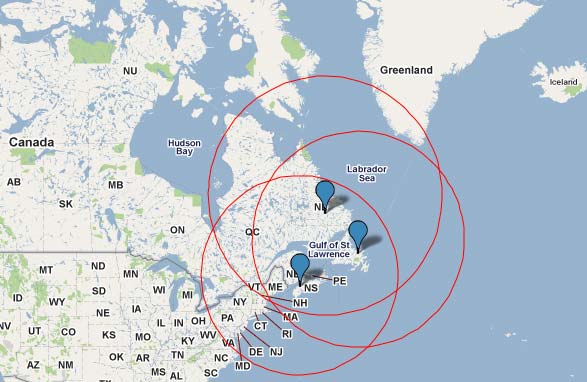
The effective radius of the F-35 is 590 nautical miles, or 728 nm (1348 kilometres), with external tanks. That is at cruising speed, not full combat thrust. Adding external tanks also degrades the stealth capability of the airframe.
The F-35 can be refuelled while in flight, but not from Canada’s two CC-150 Polaris tankers, at least not in any way the F-35 is currently configured. The tankers are principally stationed at 8 Wing Trenton in Ontario, and have a fully-loaded range of 4,630 kilometres. And if an F-35 does successfully mate with a CC-130 it loses its entire stealthed profile.
Canada’s Air Force Wings
There are Air Force bases across Canada, but in regards to the Arctic only three are relevant: 5 Wing Goose Bay, 14 Wing Greenwood and CFB Gander. (The planned military training centre in Resolute Bay supports only Army personnel; the deep-water port being built in Nanisivik, on the northern tip of Baffin Island, only Navy).
There are four very small Forward Operating Locations north of the 60th parallel, but they remain deactivated except for brief visits. The FOL’s are in Rankin Inlet, Nunavut, Inuvik, Northwest Territories, and Iqaluit, Nunavut. 440 “Vampire” Transport Squadron, operating out of Yellowknife, is the only permanently based Air Force asset in the north.
Adding F35’s To Canada’s Air Force Means No Effective Force Projection Into The Northwest Passage
As you can see from the map above, the operating radius of the F-35 from Goosebay, Greenwood and Gander, even with external tanks, is severely limited.
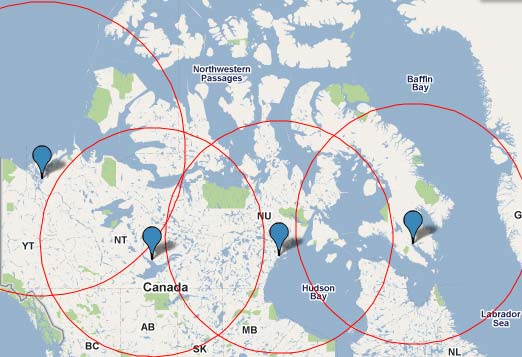
Deploying the aircraft from the Forward Operating Locations – of which Yellowknife is the only one that is permanently staffed, and all of which would require major upgrades in order to house and maintain F-35’s – still does not provide complete coverage of the Northwest Passage for surveillance or combat. Pushed to their limit and given an exact target location, the aircraft would be able to dip below cloud cover, take one shot, and then be forced to immediately return to base. Scrambled from the FOLs under full combat thrust, they would never make it to the strait at all.
Arctic Night and a Single Engine Is Not a Good Combination
As the Canadian Air Force is pushed further north it will encounter harsher conditions, higher maintenance costs, and inevitable loss of both airframes and lives. The most extreme example of this is CFS Alert, an armed services station for signals and intelligence interception. Alert is the northernmost facility in the world that is permanently inhabited by human beings, who’s motto is “The People of the Land Beyond the Land Beyond”. The base is in complete darkness from mid October to the start of March, and experiences polar weather year-round; these conditions have caused the loss of two aircraft and fourteen lives in a period of 40 years.
The F35 is a single-engine aircraft; if that engine fails to light while in the air the pilot has little choice but to eject (like most modern fighters, the F35 does not have the ability to glide unpowered; its continued flight depends on constant thrust).
In summary, the F-35 is an airframe that is hugely expensive and remains untested in Canadian conditions. It is neither appropriate for Canada’s traditional military role of the last 60 years – that of peacekeeping support – nor can it fulfill the requirements for the nation’s strategic interests over the next half-century.
As I don’t believe in criticism without providing alternative solutions, an upcoming article will suggest a very different, less expensive and far more effective alternative for Canada’s Air Force.